
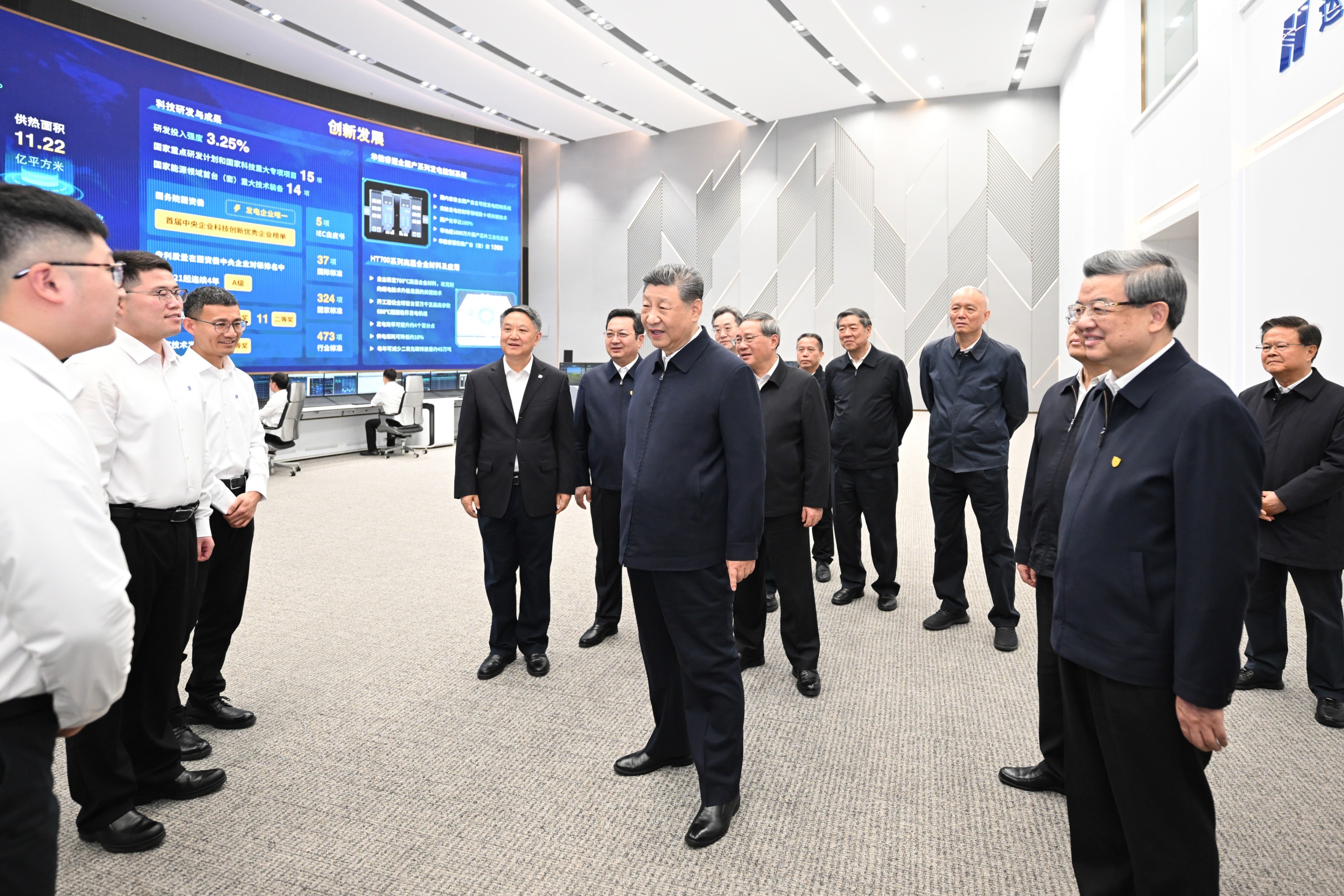
Chinese President Xi Jinping, also general secretary of the Communist Party of China Central Committee and chairman of the Central Military Commission, visits China Huaneng Group Co., Ltd. in the Xiong'an New Area, north China's Hebei Province, March 23, 2026. (Xinhua)
A light bulb is not something most people would associate with governance.
Yet nearly four decades ago, while working in one of the poorest parts of east China's Fujian Province as the Party chief of Ningde Prefecture, Xi Jinping told local officials that ensuring access to everyday necessities for people living in remote areas, even items as basic as light bulbs and soap, was also a measure of good governance.
This remark highlighted a universal and profound question: should one uate an official's performance based on short-term economic gains, visible projects, formal accolades, or tangible improvements in people's well-being?
Xi answered with what he described as "a correct understanding of what it means to perform well," a guiding principle for officials that prioritizes people's well-being and values long-term, tangible results that may not be immediately visible, yet delivered through sound decision-making and concrete actions.
In late February, the Communist Party of China (CPC) Central Committee, with Xi at the core, initiated a Party-wide study campaign, prodding its members, particularly officials at the county and director level and above, to fix their mindset regarding governance performance so as to deliver results that "stand up in practice, in the eyes of the people, and over the course of time."
The campaign, which will run until July, aims to correct misguided views on governance that often breed vanity projects, hidden risks, heavy burdens on local communities, and public discontent.
It marks the latest effort by Xi, who is now general secretary of the CPC Central Committee, Chinese president, and chairman of the Central Military Commission, to strengthen the Party's self-governance, following last year's initiative on improving conduct.
"The ever-improving effectiveness of the Party's self-governance is the ultimate guarantee for economic and social development," Xi said.
That emphasis was reiterated during an inspection tour on March 23, when Xi stressed Party leadership and Party building in developing the Xiong'an New Area -- a fledgling modern city about 100 km south of Beijing -- into an innovation hub and a model of high-quality development. Xi urged Xiong'an officials to step up to their responsibilities, devote themselves to policy implementation and deliver good results.
Party theorists said the latest study campaign focuses on strengthening the Party's political development and its ranks of officials. As China has entered the opening year of the 15th Five-Year Plan (2026-2030), the fulfillment of its development goals will largely depend on whether officials act with a proper understanding of governance achievement and a down-to-earth approach.
Eduardo Regalado, a researcher at Cuba's International Policy Research Center, said fostering a correct view on performance among officials has emerged as a key concept in the CPC's governance framework for the new era, and will help China transform its development model toward greater quality, efficiency, and equity.
PEOPLE FIRST
A key target of the campaign is to stamp out the tendency among some officials to sacrifice public well-being in seeking to polish their performance records.
At a high-level meeting, Xi condemned the squandering of funds on facade painting in some rural areas at a time when they had freshly shaken off poverty or were still grappling with poverty.
Xi said spending lavishly to whitewash the walls there -- something that neither feeds nor clothes the people -- is "futile and a waste of public funds."
While some officials err on the side of recklessness, some others deliberately choose inaction. Some play it safe and shy away from responsibility, believing that "the more dishes you wash, the more you break."
Xi has on many occasions lashed out at such non-acting "nice guys" and "fence-sitters," saying that those who lack dedication will achieve nothing and jeopardize critical endeavors.
Conversely, one paragon of good governance frequently cited by Xi is Jiao Yulu, a humble Party chief of the little-known rural county of Lankao in central China's Henan Province in the early 1960s.
Confronted with sandstorms, floods and widespread soil salinization that left many residents struggling to feed themselves, Jiao and his colleagues worked tirelessly to plant shelter-belts in combating encroaching sands and flooding, and help Lankao gradually overcome chronic food shortages. However, Jiao did not live to see the full results of these efforts, succumbing to liver cancer at age 42 in 1964.
Xi was deeply moved when he first read Jiao's story as a middle school student. He said Jiao's spirit, defined by a people-first approach and tireless, selfless dedication, had served as a guiding light throughout his own journey from a grassroots official to China's top leader.
In the early 1980s, while working in Zhengding County in north China's Hebei Province, Xi helped cut the state grain procurement quotas that had earned the area a reputation as a "high-yield county" -- after learning that some farmers there were left without enough to eat.
"Zhengding would rather give up the fame as a national model for high grain production than compromise the well-being of our people," he said.
For Xi, governance should be guided by the needs of the people rather than political showmanship. An official's true pursuit, he has said, should not be high office, but living up to people's expectations.
Drawing on his firsthand experiences of rural hardship as a teenager, Xi launched a nationwide campaign to eradicate extreme poverty shortly after assuming the Party's top post in November 2012, mobilizing the entire Party apparatus toward the goal. Under his leadership, China lifted nearly 100 million rural residents out of absolute poverty in eight years.
Viewing poverty alleviation not as an endpoint but a stepping stone toward the people's expectations of a better life, Xi then pivoted to a broader vision -- pursuing common prosperity for all, and building a great modern socialist country by the middle of the century.
But setting the right goals is only part of the task. Xi has therefore placed strong emphasis on improving the institutional framework governing officials' conduct. He has stressed that, alongside fostering the right mindset, it is essential to strengthen systems that constrain and supervise the exercise of power.
Meanwhile, to encourage officials to take on responsibilities, Xi set clear selection and appointment benchmarks.
Officials who make errors with good reform intentions or due to lack of experience must be protected and distinguished from those who violate discipline and law deliberately or to seek illegal gains, according to the "three distinctions" principle he proposed.
"Officials should be selected and promoted based on what they have done, what they have accomplished, and whether their work is recognized by both the Party and the people," Xi said in remarks published in Qiushi, the Party's flagship magazine, in March after the study campaign's launch.
"Preference must be given to those who dare to take responsibility, show initiative, deliver results adeptly and demonstrate outstanding performance," Xi said.

版权及免责声明:凡本网所属版权作品,转载时须获得授权并注明来源“欧洲侨报”,违者本网将保留追究其相关法律责任的权力。凡转载文章,不代表本网观点和立场。版权事宜请联系:0040-751021899。
 视频丨习近平出席美国总统特朗普在白宫举行的欢迎仪式
版权所有:欧洲侨报苏ICP备17070786号-1
